
Files and SFTP
The File Manager provides browser-based access to your server directory. Its SFTP tab creates a temporary login for a desktop file-transfer client.
Use File Manager for a quick edit or a few files. Use SFTP for a larger folder tree or repeated transfers. Both methods remain limited to your assigned server and customer file policy.
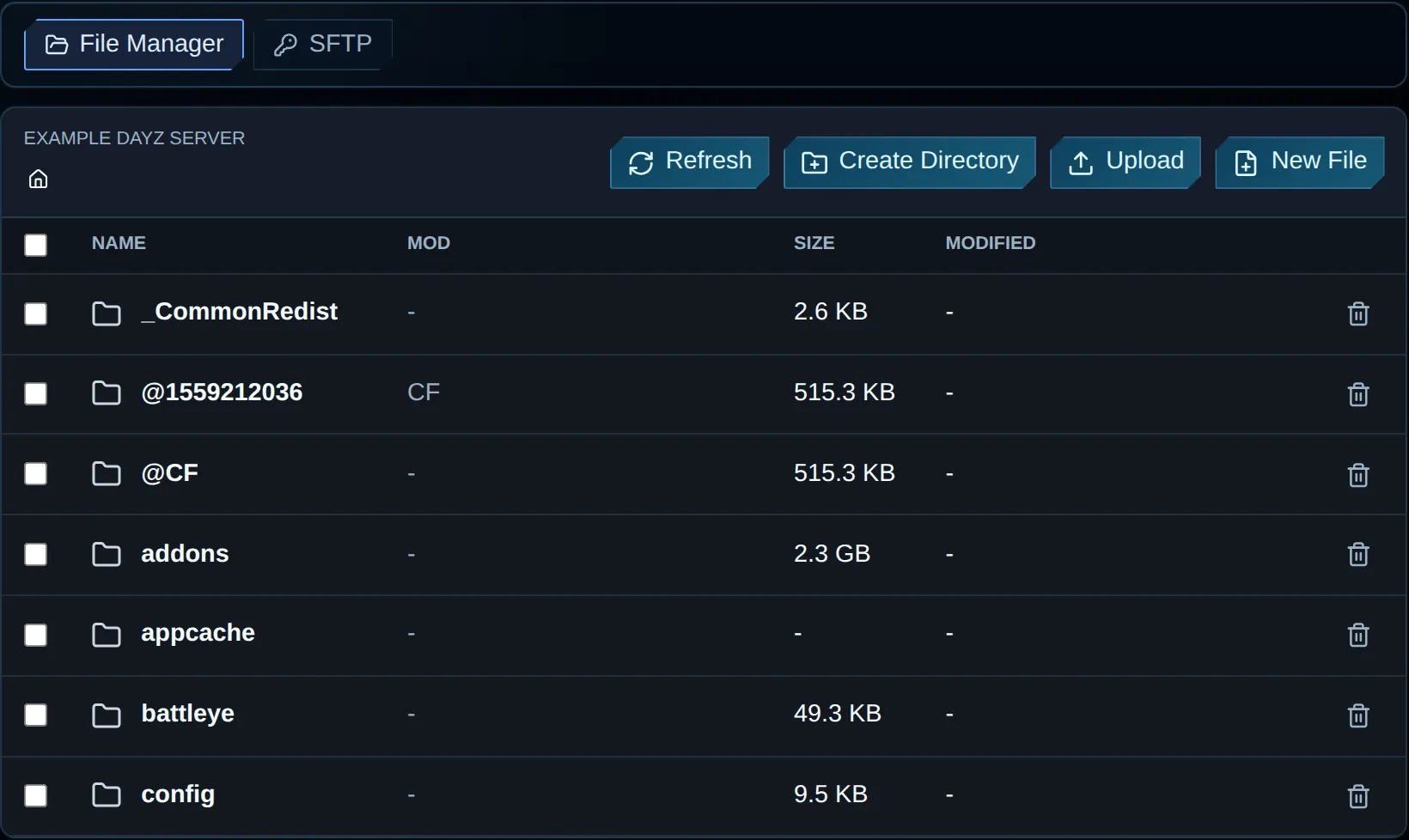
Use the path controls and folder rows to navigate. File creation, upload, and delete controls appear only when your policy permits them.
Choose a file access method
Section titled “Choose a file access method”| Method | Best for | Trade-offs |
|---|---|---|
| File Manager | Quick edits, single uploads/downloads, archives, and changes from any browser. | Large transfers are less convenient; allowed operations and sizes may be limited. |
| Temporary SFTP | Moving many files with FileZilla, WinSCP, Cyberduck, or another SFTP client. | Requires a client; the one-hour password is shown once and must be handled securely. |
Navigate in File Manager
Section titled “Navigate in File Manager”- Select a folder name to open it.
- Use the breadcrumb trail or back control to return to a parent folder.
- Select Refresh after a change made through SFTP or another session.
- Tick row checkboxes to use a supported bulk action on multiple entries.
Folder sizes are calculated from the file tree currently returned by the host. A blank or delayed size does not mean the folder is empty.
Create and upload
Section titled “Create and upload”| Control | What it does |
|---|---|
| Create Directory | Creates a directory inside the current path. |
| New file | Creates an empty file, then opens it in the editor. |
| Upload | Uploads a selected local file into the current directory. |
File names must not contain path separators. Upload size, request frequency, and blocked extensions depend on your customer file policy. Executable or other high-risk extensions may be rejected even when ordinary text files are allowed.
Edit a text file
Section titled “Edit a text file”- Select the file name.
- Confirm the editor language shown for the file:
JSON,XML,CFG, orTXT. - Make the change.
- For JSON or XML, use Format and Validate before saving when those controls are available.
- Select Save.
- Wait for the success message before opening another file.
The panel preserves the file’s existing line-ending style when it saves. A truncated preview is read-only because saving incomplete content would overwrite the full file.
If you navigate away with unsaved changes, the panel asks whether to discard them. Format changes layout; Validate checks structure. Neither action writes to the server until you select Save.
Download, archive, extract, and delete
Section titled “Download, archive, extract, and delete”| Action | Meaning |
|---|---|
| Download | Downloads one allowed file to your browser. |
| Archive | Creates a ZIP archive from selected files or folders. |
| Extract | Extracts a .zip archive into the server filesystem. |
| Delete | Permanently removes the selected file or directory after confirmation. |
Archive/extract support is intentionally limited to ZIP. An operation may be blocked by file policy, size limits, or request-rate limits.
Before extracting, check that the archive has the expected top-level folder. Otherwise its contents may be placed directly into the current directory. Before deleting a directory, make a backup or download anything you might need later.
Generate temporary SFTP access
Section titled “Generate temporary SFTP access”
The SFTP tab does not reveal a standing password. Select Generate only when you are ready to save the one-time connection details securely.
- Open File Manager, then select the SFTP tab.
- Select Generate.
- Copy the Host, Port, Username, Password, and Host key if one is shown.
- Add a new SFTP connection in your client. Do not choose plain FTP or FTPS.
- Verify the server host-key fingerprint when your client asks.
- Enter the one-time displayed password.
You can also select Launch SFTP client if your computer has an application registered for sftp:// links. Manual setup is more predictable because not every browser has a compatible handler.
Only one active temporary session is available at a time. It expires after one hour. The password is shown only when the session is created; generate a new session if you lose it.
Background transfers and connection limits
Section titled “Background transfers and connection limits”The temporary username and password can support more than one client connection at the same time. Newly generated credentials allow five concurrent connections by default, although your service may use a different limit. A browsing connection uses one slot, leaving up to four for background transfers when no other client is using the same credentials.
If browsing works but WinSCP background transfers repeatedly ask for the password, and the credentials have not expired, the prompts usually point to exhausted connection slots rather than a wrong password. Close unused connections and reduce parallel transfers, then use a foreground transfer if the prompts continue. Re-entering the same password does not free a connection slot.
Credentials created before a connection-limit change keep their original limit. Finish any active transfers, select Revoke, then Generate and reconnect with the new username and password to receive the current limit.
Revoke an SFTP session
Section titled “Revoke an SFTP session”The SFTP tab lists recent sessions with their state and expiry. Select Revoke on an active session to disable it immediately. Expiry or revocation ends authentication but does not undo file changes already made through the session.
Troubleshooting
Section titled “Troubleshooting”| Problem | Check |
|---|---|
| A file will not open | It may be too large, binary, restricted, or outside the allowed root. Download it if allowed and use the correct local tool. |
| Save is disabled | The file may be truncated/read-only, the policy may block editing, or no change has been made. |
| Upload or download is rejected | Check size and extension; wait for the operation window to reset before retrying. |
| SFTP authentication fails | Use protocol SFTP, the displayed port and username, and the newest password before its expiry. |
| Browsing works but background transfers fail | Close unused connections, lower transfer concurrency, or use a foreground transfer. Check expiry and regenerate older credentials after finishing active transfers. |
| Host-key warning changes unexpectedly | Cancel the connection and contact support before accepting the new fingerprint. |
| Changes do not appear in File Manager | Select Refresh or reopen the directory after the transfer completes. |