2.56 Tbps DayZ DDoS Attack: The Ground Zero Case Study
Our Ground Zero DayZ report records a 2.56 Tbps peak, 224.85 Mpps and 18.2 TB in a four-minute report window. Original evidence and practical protection checks.
On this page
The Ground Zero report records a peak of 2,564.43 Gbps, about 2.56 terabits per second, against the community’s European endpoint on 3 July 2026. The packet-rate peak reached 224.85 million packets per second.
The full report covers four minutes and eight seconds. Most of the early graph is quiet; the main flood rises near the end. Across the window, it records 18,213 GB of attack traffic and 12.78 billion packets. The window is not the duration of the peak.
This is the largest DayZ-customer attack we have documented at VYKIX. Its figures come from a 46-page Global Secure Layer mitigation report. The original images below show the timeline, traffic mix and work distributed across the scrubbing network.
The report establishes network scale. The operational question for Ground Zero DayZ was whether players could reach the game, which requires application evidence alongside those network measurements.
Attack summary
| Metric | Reported value |
|---|---|
| Target | Ground Zero EU endpoint (37.156.35.2/32) |
| Date | 3 July 2026 |
| Start | 20:41:37 UTC |
| Finish | 20:45:45 UTC |
| Report window | 4 minutes, 8 seconds |
| Peak bandwidth | 2,564.43 Gbps |
| Peak packet rate | 224.85 Mpps |
| Total traffic | 18,213 GB |
| Total packets | 12,778.34 million |
| Dominant protocol | UDP, more than 99.99% |
| Main recorded destination port | 27017 |
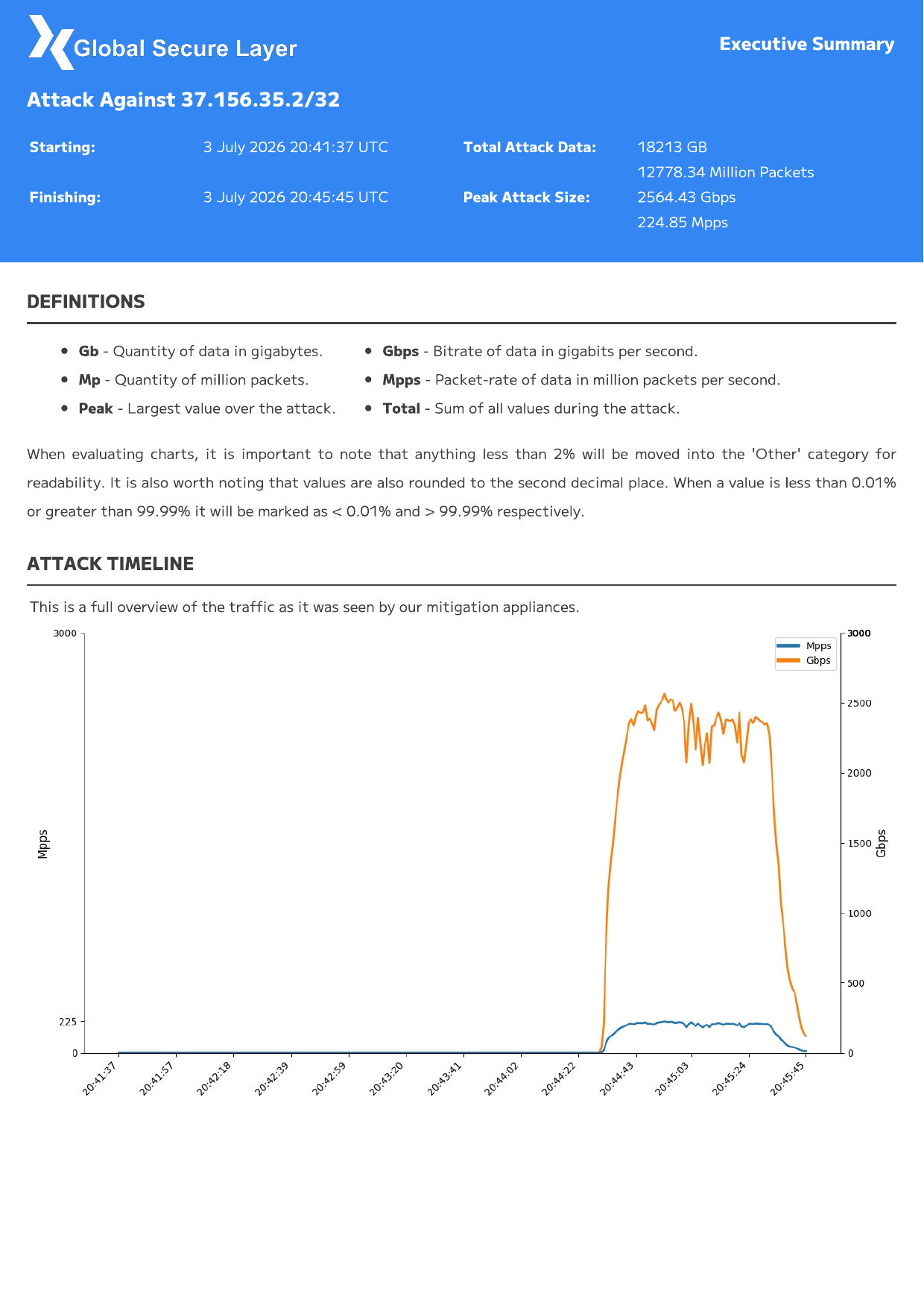 The report’s executive summary. The chart shows the flood rising to roughly 2.5 Tbps, holding near that level, then dropping after 20:45 UTC.
The target: Ground Zero’s European DayZ network
Ground Zero’s public server list describes modded Chernarus servers in Europe and the US, with group limits, solo/duo/trio play and weekend raiding. The listed servers have more than 20 mods.
The report identifies 37.156.35.2/32. Ground Zero’s official server list, checked on 15 September 2026, uses that address for EU1 and EU2. That supports the link between the report and the community. Today’s listing cannot establish the July origin topology, mods or player population.
What happened during the 2.56 Tbps attack
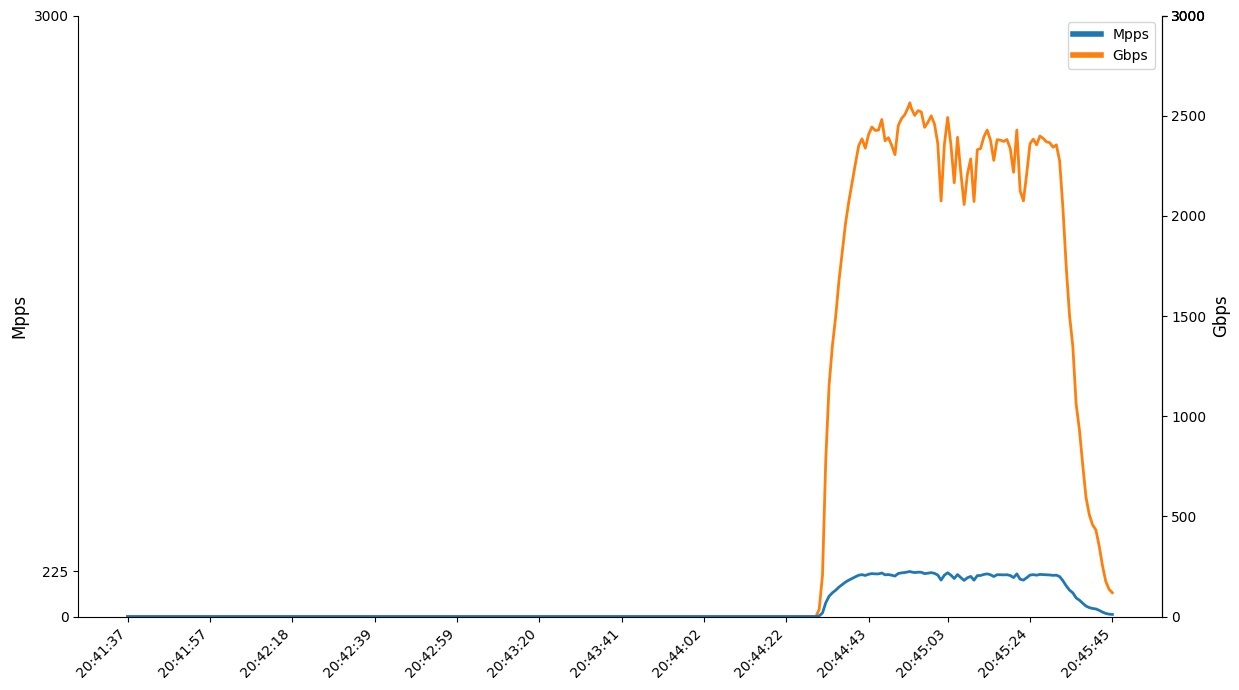
The timeline remains near zero through most of the opening window. The main rise follows about 20:44:22 UTC, then traffic holds at a high level before falling ahead of the window’s end.
The summary supplies the exact peaks: 2,564.43 Gbps and 224.85 Mpps. The image has no raw samples from which to calculate an exact duration for the high-volume interval.
The protocol table records the traffic mix:
| Protocol | Packet volume | Traffic volume |
|---|---|---|
| UDP | 12,778.29 million packets | 18,212.72 GB |
| ICMP | 0.03 million packets | Less than 0.01 GB |
| TCP | 0.02 million packets | 0.02 GB |
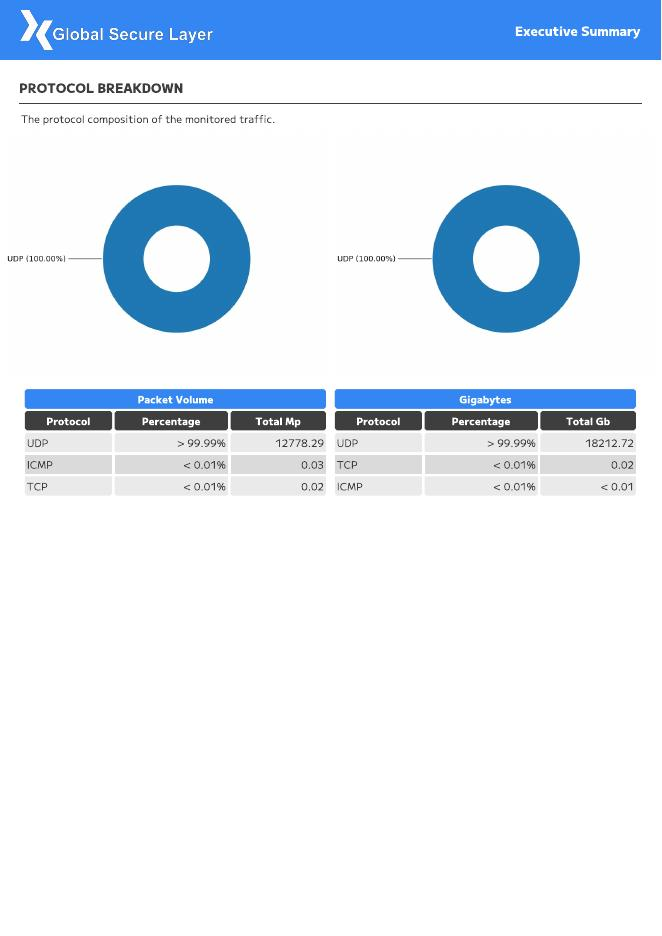 More than 99.99% of the measured packet and traffic volume used UDP.
The report groups apparent source traffic by country and network. Brazil accounts for 25.45% of recorded gigabytes, Venezuela 7.00% and Mexico 4.95%. Those classifications concern source addresses. UDP addresses can be spoofed, so these shares do not establish the attacker’s location or botnet ownership.
The scrubbing table lists 20 named sites plus Other. Miami accounts for 31.59% of the recorded gigabytes, Frankfurt 11.96% and Singapore 9.48%. That distribution shows where the scrubbing work took place.
Why a DayZ server cannot block this at the origin
An operating-system firewall handles packets after they have crossed the upstream link. Once that link is full, dropping packets on the host cannot recover the missing capacity.
That is why protection for a flood of this scale needs an upstream path with enough capacity to handle it. A provider’s response also matters: blackholing the target may protect the wider network by making that target unreachable.
Packet processing is another constraint. The report’s 224.85 Mpps peak tells us how many packets per second the mitigation layer faced. A provider needs to account for that work as well as bandwidth.
The DayZ-specific protection problem
A large UDP peak explains one part of the problem. Smaller requests can still create work on the game, join or query path.
When reviewing DayZ protection, consider what the traffic asks each service to do:
- UDP floods consume link and packet-processing capacity.
- Fake joins create connection-handling work.
- Abusive A2S queries pressure the server listing.
- Packets resembling DayZ traffic need enough context to distinguish valid game exchanges.
A blanket UDP block would also remove the paths players use. The filter needs to distinguish traffic using the game and query controls available for the deployment.
How VYKIX approaches DayZ DDoS protection
We combine upstream network filtering with controls for game traffic. Each part answers a different question about what should reach the server.
Edge mitigation absorbs the flood
The Ground Zero report records scrubbing across multiple sites. Upstream filtering is where traffic can be discarded before it consumes the game server’s own link and processing resources. The report documents that mitigation activity, without quantifying what reached the origin.
New connections are controlled
Connection controls address requests that would otherwise make the server spend resources on clients that do not complete a valid session. Established traffic needs different handling from untrusted new traffic.
Invalid game traffic is removed early
DayZ-aware checks consider expected packet structure and session behavior. Rejecting invalid traffic upstream reduces the work sent to the game process; a port number or matching signature alone cannot authenticate a session.
A2S queries are protected and cached
A failed listing can stop players finding a server even when its game process is running. We cache supported DayZ A2S_INFO requests to reduce repeated listing-query work at the origin.
Check game joins alongside those cached replies. A listing response is not a health check on the game process.
The GSL report records destination port 27017 but does not classify this event as an A2S attack. We include query protection here because it is part of the DayZ traffic path, not because the port proves this incident’s vector.
What the DayZ filter telemetry shows
The following VxShield captures are a separate dataset. The drop-mix tooltip shows 4 August 2026, one month after the July GSL report. These images explain filter decisions on the Amsterdam-labeled edge; they do not measure the July 2.56 Tbps peak.
DayZ containment rate
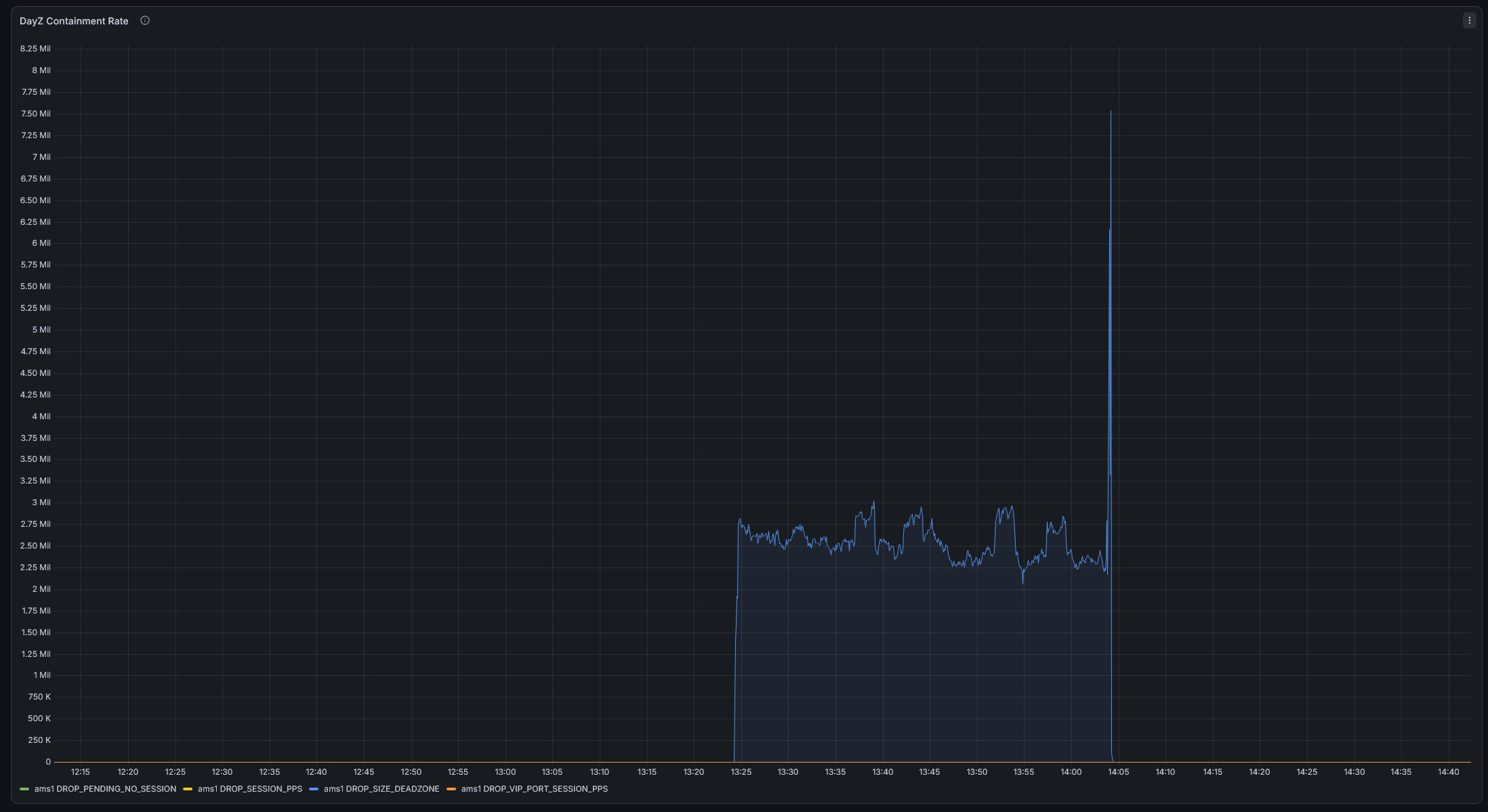 DayZ containment telemetry from the Amsterdam edge. The
 DROP_SIZE_DEADZONE series carries the sustained activity between about 13:25 and 14:05 on the chart’s scale.
The DayZ series sits around 2.3 million to 3 million on the displayed scale, with a short rise above 7.5 million near the end. It separates a named DayZ decision from generic network drops. Those counters cannot be converted into bandwidth or player counts.
Drop reasons stay visible
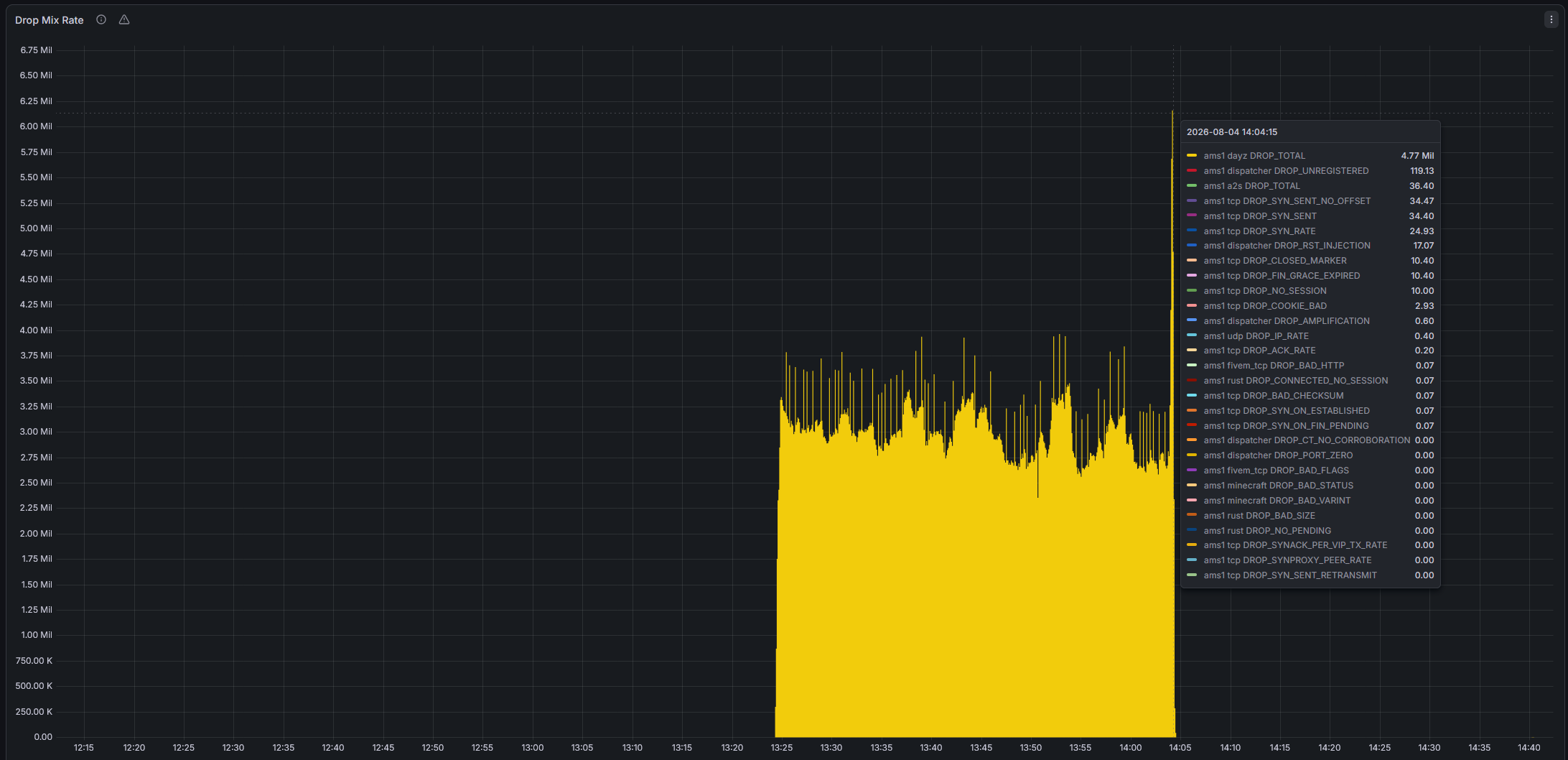 At the selected 14:04:15 sample, the dashboard shows 4.77 million on the
 dayz DROP_TOTAL series. Other filters remain broken out by protocol and product.
The separate A2S, TCP, UDP, dispatcher and game counters make it possible to inspect which path is active. A total alone would hide that distinction.
Session proof and ACK outcomes
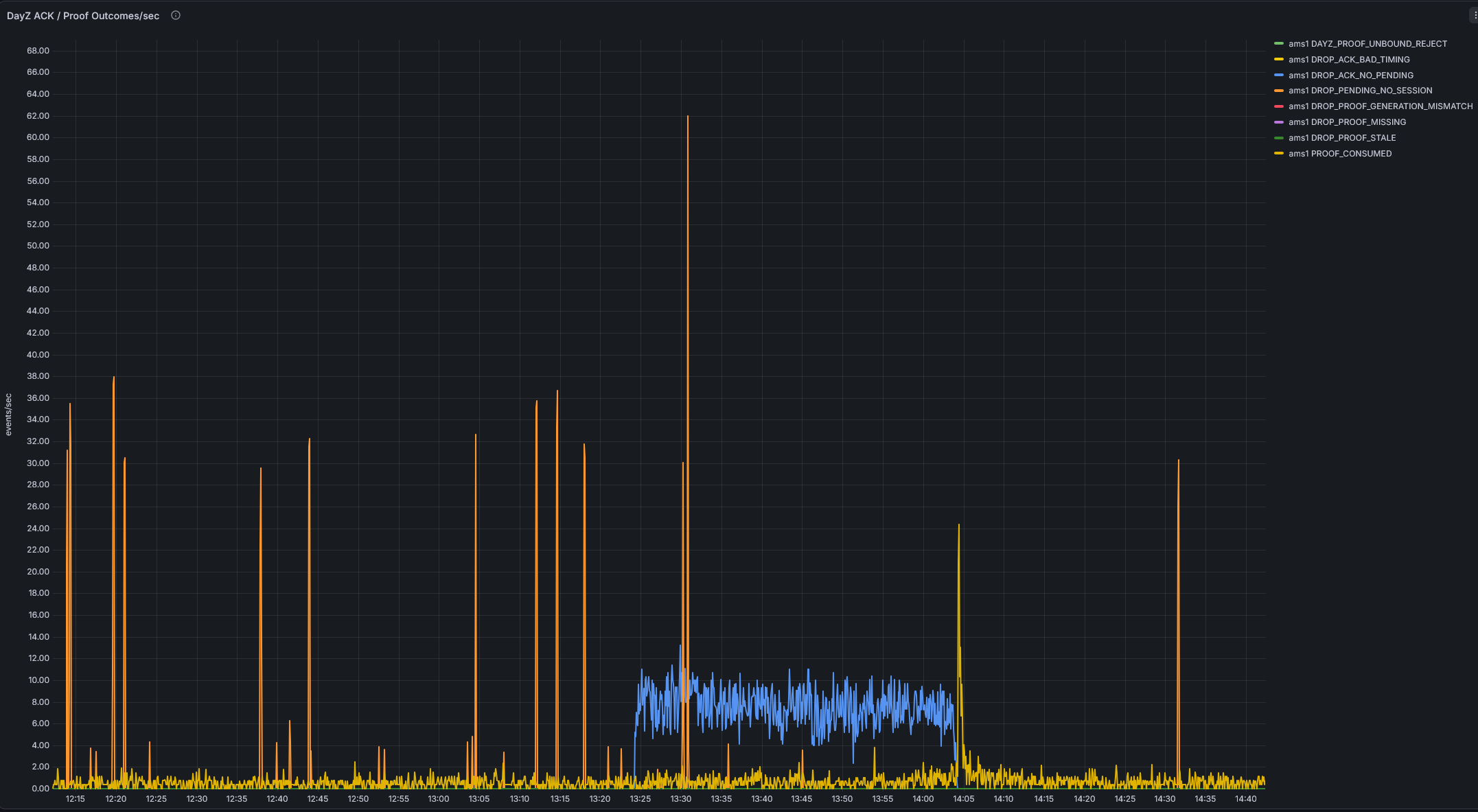 DayZ ACK and proof outcomes from the Amsterdam edge. Each line records a specific session or proof decision rather than one aggregate drop count.
The labels include DROP_ACK_NO_PENDING, DROP_PENDING_NO_SESSION, DROP_ACK_BAD_TIMING, DROP_PROOF_MISSING, DROP_PROOF_STALE and PROOF_CONSUMED.
These are the kinds of stateful decision an engineer needs to inspect. A packet can use the expected protocol and port but arrive with no pending session, stale proof or invalid timing. Separate counters make those cases visible when reviewing the filter.
What the report proves
The July report supports the recorded target, peaks, totals, protocol mix and scrubbing distribution. Ground Zero’s public listing supports the community association.
It does not include player-session logs, game-process telemetry or an independent uptime monitor. We would need those records to state a precise disconnect count or zero application downtime. It also cannot establish a worldwide attack record; our claim is limited to the largest DayZ-customer event VYKIX has documented.
Lessons for DayZ server owners
Ask for both Gbps and Mpps capacity
Check what the provider does when bandwidth or packet processing becomes the limit. Ask whether mitigation can end in a blackhole and what the incident record will show.
Confirm that protection covers the DayZ traffic path
Ask about player joins, game packets, A2S queries and origin isolation. Check the product and active profile, then verify the paths you intend players to use.
Treat server-browser availability as part of uptime
Record listing responses and game joins as separate observations. A working query reply does not prove a healthy game process, and an unavailable listing can still prevent a player finding it.
Demand evidence with enough context to audit
Keep the target, timestamps, units, peaks, totals and protocol breakdown together. When the question is player impact, collect application records for the same interval.
Common questions
How large was the DDoS attack against Ground Zero DayZ?
The GSL report records peaks of 2,564.43 Gbps, about 2.56 Tbps, and 224.85 million packets per second. Its window runs from 20:41:37 to 20:45:45 UTC on 3 July 2026, including a quiet lead-in before the main flood.
Was this the largest DayZ DDoS attack ever recorded?
This is the largest DayZ-customer attack VYKIX has documented. We cannot verify a worldwide record because no public authoritative registry covers every DayZ attack.
What type of attack hit the DayZ server?
UDP accounts for more than 99.99% of the report’s packet and traffic volume: 12,778.29 million packets and 18,212.72 GB. The destination port alone does not establish an A2S attack.
What should DayZ DDoS protection cover?
Check upstream flood handling, packet-processing capacity, new-connection controls, game-packet validation and A2S query protection. Ask for separate application records to establish whether players could stay connected.
Does A2S query caching protect a DayZ server?
Caching supported A2S_INFO replies reduces repeated server-browser query work at the origin. The game, connection and upstream traffic paths still need their own controls; a cached reply does not prove that the game process is healthy.
Protect your DayZ server before the next attack
VYKIX DayZ hosting includes VxShield and DayZ-aware traffic controls, with supported A2S query caching. Review the selected plan’s total, including VAT and unavoidable fees, in the live portal.
Our switcher offer includes best-effort migration and seven days added to the paid plan once eligibility and scope are confirmed; terms apply.
See DayZ server hosting plans | Read the DayZ DDoS protection guide | Visit Ground Zero DayZ
Game-aware DDoS protection for your server.
Run your game server with VxShield included. Ask about free migration and seven days free for eligible customers switching hosts. VYKIX confirms the scope, timing, and terms before the move.
Continue with